Page Index
The things that surround us in our daily lives gradually become worn and sometimes damaged with the passage of time. The same is true for exhibits and objects shown in galleries and museums.
No doubt you have seen objects from two hundred, three hundred, or even several thousand years ago. It’s really quite marvellous that they remain to this day. There are so many objects that would no longer exist if they had simply been put away and left un attended.
The professionals engaged in restoring and repairing objects so that they will survive into the future are known as conservators, and “conserve” here means “preserve” and “protect.” In Japan, several terms are used for such professionals, including shūfukushi (restorer), shūri gijutsusha (restoration technician), hozon shūfuku senmonka (preservation and restoration specialist). Most of the time, you are probably not aware that such people even exist.
This article focuses on Sōkō, the restoration of Japanese artworks in traditional formats such as hanging scrolls and handscrolls, which is part of the field of conservation (hozon shūfuku).
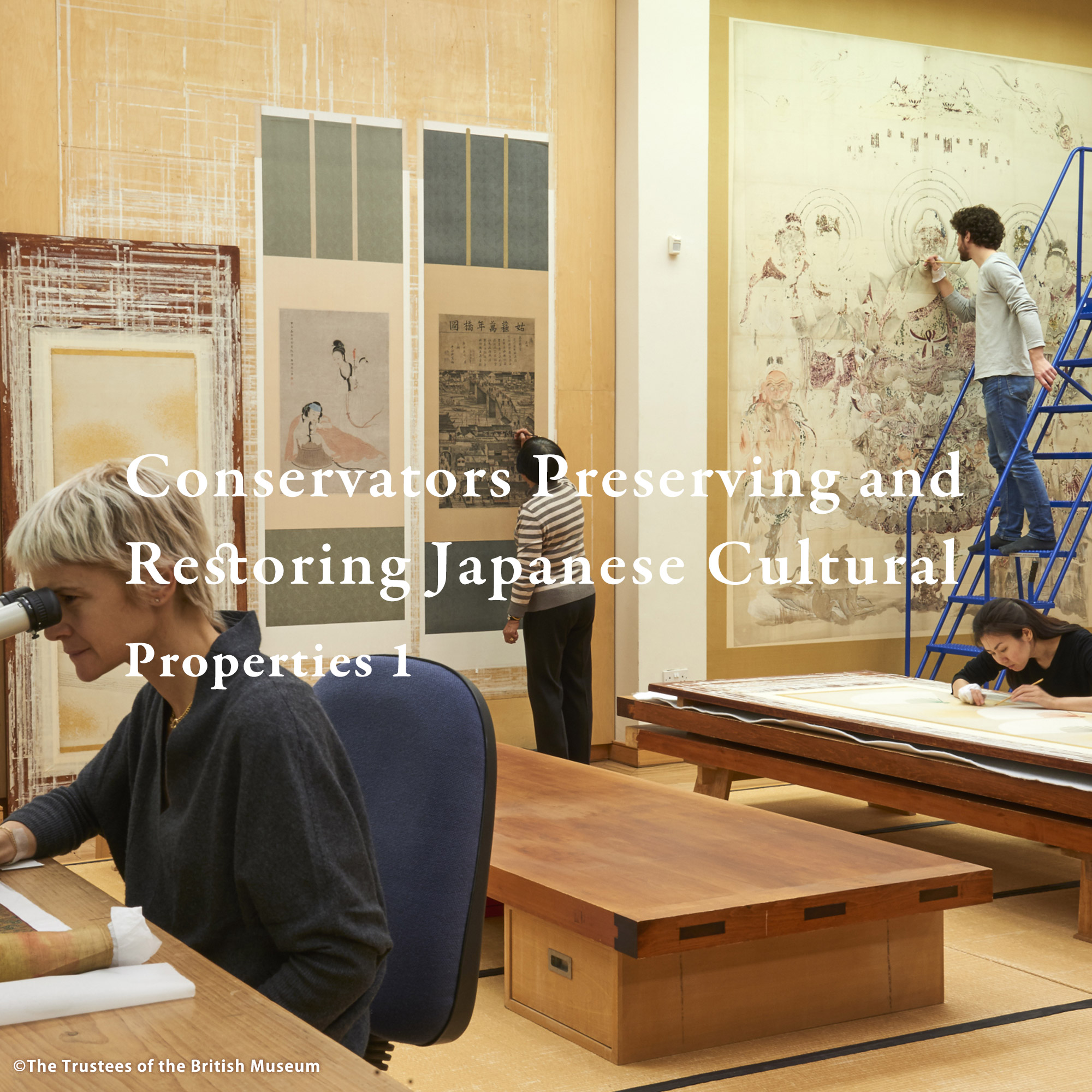
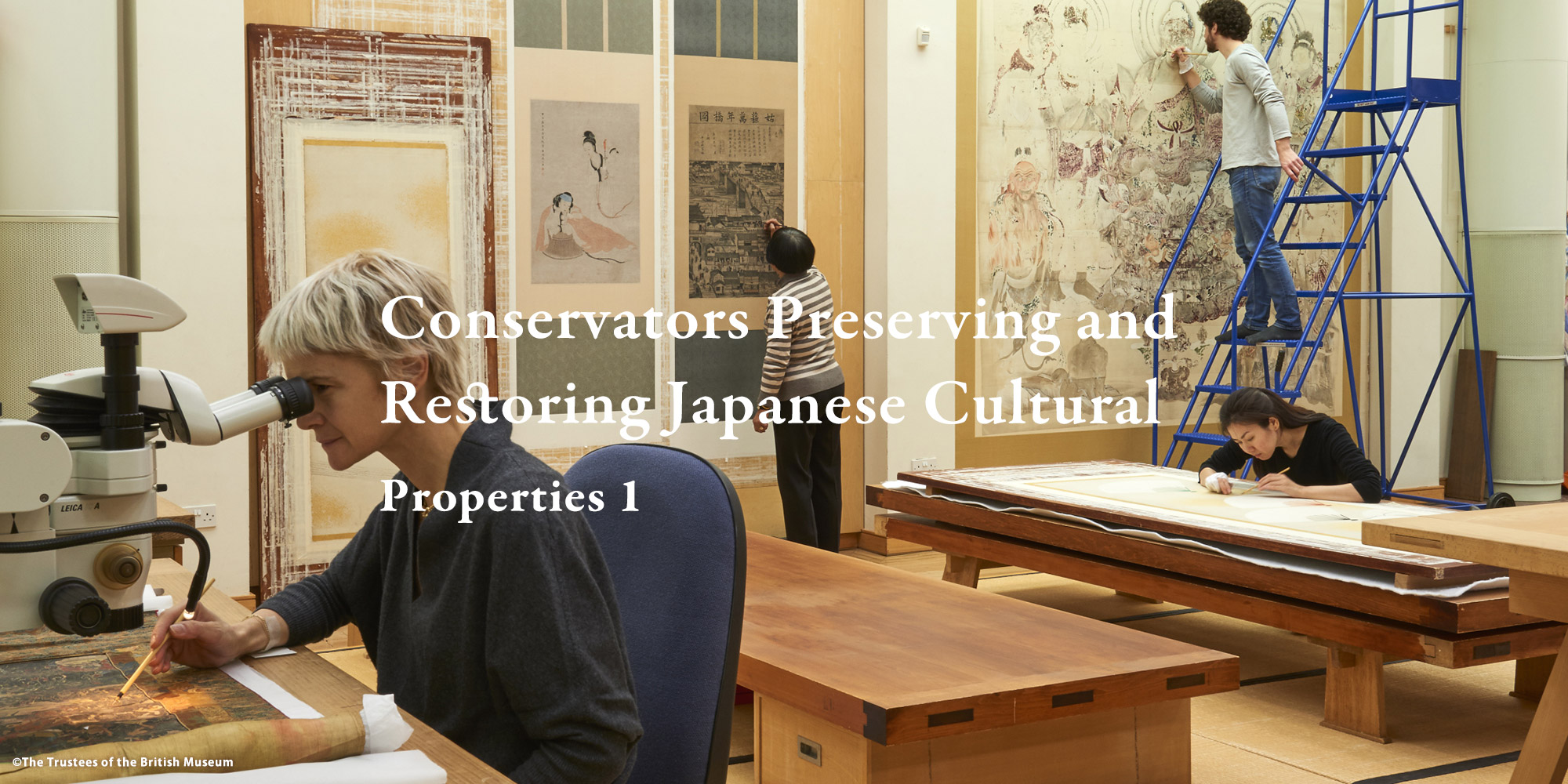
Our interview took place in London, England’s capital city, at a tatami-floored conservation studio within the world-famous British Museum, where Japanese cultural heritage objects are being cared for on a daily basis. There, we spoke with Kusunoki Kyōko, a Japanese conservator working in this studio.

Kusunoki Kyōko
Born in 1979, Kusunoki studied archaeological science at Nara University of Education and graduated in 2002. In 2004, after receiving her master’s degree in Cultural Property Conservation from the Graduate School of Tokyo University of the Arts, she joined Bunkazaihozon, Ltd., based at the Conservation Center for Cultural Properties, Nara National Museum, where she specialized in the conservation of Japanese paintings. From 2011 she served as an Associate Fellow at the Tokyo National Research Institute for Cultural Properties. Within the Institute’s Cooperative Program for the Conservation of Japanese Art Objects Overseas, she participated in of Japanese paintings held in museums overseas. She served as a lecturer for workshops held not only in Japan but in Germany and Mexico, sharing scroll mounting techniques and materials with conservators overseas. In 2015, she attained the title of Chief Conservator, certified by the Association for Conservation of National Treasures. In 2016 she moved to England where she is currently employed as a conservator of Japanese paintings at the Hirayama Studio in the British Museum.
The Role of a Scroll Mounting Conservator
Morio
Please tell us about your current position at the British Museum and what led you to this point in your career.
Kusunoki
I am currently a conservator of Japanese paintings in the Hirayama Studio at the British Museum in London, now in my eleventh year in the role.
As an undergraduate at the Nara University of Education, I studied dating and provenance of archaeological earthenware, stoneware, and other artifacts. Later, at the Tokyo University of the Arts, I specialized in conservation science at the Graduate School of Conservation.
After receiving my master’s degree, I joined a conservation company in Nara, where I trained in scroll mounting conservation from the basics. After seven years there, I spent five years as an Associate Fellow (limited-term researcher) at the Tokyo National Research Institute for Cultural Properties.
When I was first hired, I expected to be researching conservation materials and methods at the Centre for Conservation Science, but following later organizational changes, I was assigned to the Centre for International Cooperation in Conservation.
As a result, I became involved in surveys of Japanese artworks overseas, which eventually led to my current position.
Sōkōshi
Sōkōshi are specialists who conserve hanging scrolls, handscrolls, and other works of painting and calligraphy executed on silk or paper.
Sōkō refers to the mounting and conservation techniques that enable such works to be both preserved and appreciated. In order to conserve works executed on such inherently fragile materials, the mounts that support these works must be repeatedly replaced or repaired over time. The techniques and the materials required dismantle and repair these works without causing damage, and have been passed down on the premise of continued conservation.
Morio
What led to your becoming a sōkōshi (scroll mounting conservator)?
Kusunoki
I first learned about sōkō (scroll mounting conservation) in my third year of university. In a class taught by a professor who specialized in conserving traditional mural paintings, I watched a documentary showing the conservation of the Illustrated Biography of Priest Ippen handscrolls. Since it was the professor’s wife who had carried out the conservation, I was able to ask various questions and learn more about that field of work.
Morio
What kind of training is required to become a sōkōshi (scroll mounting conservator)?
Kusunoki
The most common route is to work and train in a conservation mounting studio. While working for several years, one goes through a number of stages and takes qualifying examinations. Some universities also offer courses related to scroll mounting and conservation, so some people begin by studying these subjects at university before going on to train in a studio.
Morio
What is your current job title in English?
Kusunoki
My job title is “Conservator for Japanese Paintings,” which sometimes needs clarification – in the West the word “painting” is often associated with “easel/oil paintings,” but I work mainly on Japanese paintings on paper and silk with traditional Japanese pigments.
It is sometimes difficult for people to understand that there is a difference between the idea of a “painting” in English and Japanese. In Japan, when speaking to people who are familiar with the term sōkō (scroll mounting), I introduce myself by saying I do “sōkō,” but for those who may not know the term, I say “I restore Japanese paintings.” I find that people are not always familiar with the term “conservator,” whether in English or Japanese.
Conservators at the British Museum
There are currently 57 conservators in the Conservation Team (as of February 2026). They are divided into the following specializations:
https://www.britishmuseum.org/our-work/departments/collection-care/conservation
Inorganics: Stone, wall paintings and mosaics, ceramics, glass, and metals, facsimile (high-quality replicas)
Organics: objects made from plant and animal materials such as wood or bone, textiles and costume, painted decorative surfaces, human remains, Asian lacquer, plastics
Pictorial Art: Western graphic art, East, South & South-East Asian & Middle Eastern paintings and graphic art, East Asian scroll mounting, ancient papyri, photographs, ephemera, bank notes, parchment, conservation mounting
Preventive Conservation: environmental control & monitoring, materials testing, guidance & advice relating to collection care, collection risk management, IPM support (Integrated Pest Management).
Communing with the Past
Morio
I personally enjoy examining and observing art works, but for you as a conservator, what is the most enjoyable part of your work?
Kusunoki
I would say it is the same for me: the “examination” and “observation” of artworks. As suggested by the concept of this article, by examining and handling art objects, we can connect ourselves with the often-hidden stories in their background, and I think that is what we conservators are most passionate about.
Of course, the actual process of conservation treatment is in itself fascinating, but there is also something exciting about being able to peer through a microscope and observe each and every particle of the materials from which an artwork is made.
Another interesting thing is that we can see the traces of previous restorations that have been made in the past.

Morio
Are there times when you find that the restorations done in the past are rather poorly done?
Kusunoki
There are cases like that, but mostly we have to admit that they did their best. It makes us realize that we have to do our best as well! (Laughing)
Morio
So that’s a kind of communication of respect, isn’t it?
Kusunoki
We are doing our best with the materials and techniques available now, but from the point of view of techniques that may come into use in 300 or 400 years from now, we just hope our efforts will at least be recognized.
Morio
Scroll mounting is among the nationally designated “Selected Conversation Techniques,” and is included on the UNESCO List of Intangible Cultural Heritage. Some have the impression that the methods used are refined and firmly established, but do they actually change with the times? If you find a better way of doing things, do you change your techniques?
Kusunoki
On the whole, in our scroll mounting work we use traditional techniques passed down from long ago and follow established styles and procedures in the use of materials and tools. But—and this may be partly my own wishful thinking—I don’t think the profession is against incorporating new techniques, materials, or methods that would allow for better quality conservation.
Hanging scroll
A hanging scroll is a traditional format used in Japan for displaying a painting or calligraphy on a wall. The painting or calligraphy is mounted with washi paper and silk fitted with rollers made of bamboo, wood, or other materials, and hung in a tokonoma alcove or appropriate setting. The work is unrolled and displayed only when being appreciated, and otherwise is rolled up for storage. This not only makes it compact but protects it from deterioration caused by exposure to light, dust and the air.
(A) ichimonji: two horizontal strips of textile directly above and below a painting measuring the exact width of the painting, forming a part of the mount
(B) chumawashi/chuberi: portions of textile which run alongside the honshi (area of the painting or calligraphy) on all four sides, above and below the thin horizontal borders (ichimonji) and to the right and left of the honshi proper.
(C) jōge/ten-chi: top section (jō/ten) / bottom section (ge/chi)
(D) fūtai: decorative free-hanging strips
(E) hassō: top stave
(F) nakajiku: bottom roller
(G) jikusaki: decorative roller knob attached at each end of the bottom roller

Morio
A British Museum YouTube video shows you explaining the way the full-size tracing of one of the murals at Hōryūji Temple was conserved and mounted. I noticed that the names of the people involved in the project were recorded inside the mount, inscribed on the bottom roller. That’s very interesting. Is it a Japanese tradition?
Kusunoki
That practice is mainly found in Japan. When I was working in Nara, we routinely recorded the names of the people involved in the project in an inconspicuous place of the mount.
Morio
It’s like a time capsule. When you dismantle an old scroll, do you sometimes find the name of someone who restored it long ago?
Kusunoki
Yes, I do find such names. Several years ago while conserving a painting of Prince Shōtoku, I found it inscribed with Fudōson (the deity Fudō (Sk. Acalanatha)) on the top and bottom rollers, instead of the name of the restorers. Apparently the roller had been recycled from the mount of a painting depicting Fudō. Finding that made us realize how materials were reused in those times.
Last year, on a scroll I had begun to conserve, Aizen Myōō (Sk. Ragaraja), I found an inscription on the bottom roller that read “restored in Kanbun 2 (1662) for the repose of the souls of the second generation”.
Morio
That must be a thrill to find! You must imagine that someday someone will find your name on such a scroll. Has this practice been continuing from long ago?
Kusunoki
I believe so. We do not know when it began, but we find such names from as far back as the seventeenth century. Long ago, temples often took the lead in restoration projects. They would call for funds (kishin) for the project. So sometimes we find not only the names of the restorers but also the parishioners who donated the funds.
Morio
In the case of the British Museum, are the names written there by the conservators themselves?
Kusunoki
In the Hirayama Studio today, I am the only person who can write Japanese, so I write everyone’s names—my own in kanji and my colleagues’ in katakana and English letters.
Morio
So the people who work in the Hirayama Studio are not only Japanese?
Kusunoki
We have Chinese colleagues in the studio. We also had a Korean colleague for a five-year project – since that concluded I have taken responsibility for the conservation of Korean paintings as well. There are currently six conservators working in the studio, from the UK, Italy, France, and Poland.
Morio
Are the techniques of scroll mounting applicable in different parts of Asia? Or are they different?
Kusunoki
Though many of the principles are similar, the materials, tools and techniques between the various traditions can be quite different! For remedial conservation treatment carried out in preparation for exhibitions or loans, I work on Korean and Chinese paintings myself, but for more extensive treatment, such as replacing lining papers or full remounting, I work with specialists in Korean or Chinese painting conservation.

Urauchi (lining)
Artworks executed on paper and silk are reinforced with a lining of washi paper. The urauchi helps prevent the artwork from sagging or wrinkling.
The lining paper is attached using a natural, water-soluble wheat starch paste, which can be removed during future conservation treatments without damaging the artwork and allowing a new lining to be applied when necessary.
 Hakurakudome, a consolidation technique, prevents pigments from flaking off. ©The Trustees of the British Museum
Understanding Water and Controlling It
Morio
What kind of things do you admire when you encounter past restoration works?
Kusunoki
When I see how papers have been cut straight and joined perfectly with only a 1-2-millimeter overlap, I am deeply impressed.
Morio
That really is a considerable feat, isn’t it?
Kusunoki
It’s very difficult. Various techniques can help us achieve a neat 1-millimeter overlap, although it does take extra care and time. Ideally, we want to join the papers directly, aiming skilfully at that precise 1-millimeter alignment.
Morio
The relationship with water—that is, knowing how paper responds to water—is important, right? Can someone who understands that relationship skilfully handle paper?
Kusunoki
Yes, as you say, understanding water and how to work with it is key. The way the paper responds to water depends on the type of paper, its thickness and the length of its fibers. One technique we use to join paper in long, continuous sheets is called “water cutting” (kuisaki). After applying moisture along a thin line on paper, we tear it along that line to create a feathered edge, which is then pasted over the join between two carefully overlapped sheets of paper.
In that case, it is not only a matter of joining pieces of paper together but also of achieving a straight and even kuisaki edge.
Morio
By “straight” do you mean that the feathered edge of the torn washi follows a straight line?
Kusunoki
Yes. Ideally, not only the feathered edge but also the base of tear line should be straight. If the force applied is uneven, the depth of the tear will vary, causing both the feathered edge and the base line to become irregular. Beginners tend to pull the paper apart too forcefully, resulting in a jagged tear.

Morio
Making a straight tear is possible because of the nature of the long fibers of the paper mulberry (kōzo) from which the washi is made, right? When the fibers are short, the fuzz turns out too short. How interesting!
Washi
Washi is a traditional Japanese paper made from fibers of kōzo (paper mulberry), gampi (a shrub of the Thymelaeaceae family), mitsumata (Edgeworthia chrysantha), asa (hemp), and other plants. The branches of those plants are steamed to remove the bark. Fibers are removed and cleaned. A solution containing these fibers is poured into a large wooden tank (sukibune). A wooden frame fitted with a mesh screen (suketa) is then scooped into the tank and drained off to create an even distribution of fibers, that hardens when dry to make a paper sheet.
Because the fibers are longer than those used in Western papermaking, washi is known for its strength and durability.
Kusunoki
Long ago, when I was still learning, I once struggled to make a straight tear, and the feathered edge didn’t align. A more experienced colleague saw it and helped me join the papers beautifully. In that way I learned the correct technique. The materials we use are important, of course, but the tools and techniques we use are equally significant. They make up an integrated, three-in-one whole: materials, tools, and techniques.
Morio
So true! Your work is only made possible when you have all three at your disposal.
※Continue to Part 2
Cooperation
The British Museum
Great Russell Street, London, WC1B 3DG
One of a kind: the Hirayama Conservation Studio
https://www.britishmuseum.org/blog/one-kind-hirayama-conservation-studio