
Page Index
The things that surround us in our daily lives gradually become worn and sometimes damaged with the passage of time. The same is true for exhibits and objects shown in galleries and museums.
No doubt you have seen objects from two hundred, three hundred, or even several thousand years ago. It’s really quite marvellous that they remain to this day. There are so many objects that would no longer exist if they had simply been put away and left un attended.
The professionals engaged in restoring and repairing objects so that they will survive into the future are known as conservators, and “conserve” here means “preserve” and “protect.” In Japan, several terms are used for such professionals, including shūfukushi (restorer), shūri gijutsusha (restoration technician), hozon shūfuku senmonka (preservation and restoration specialist). Most of the time, you are probably not aware that such people even exist.
This article focuses on Sōkō, the restoration of Japanese artworks in traditional formats such as hanging scrolls and handscrolls, which is part of the field of conservation (hozon shūfuku).
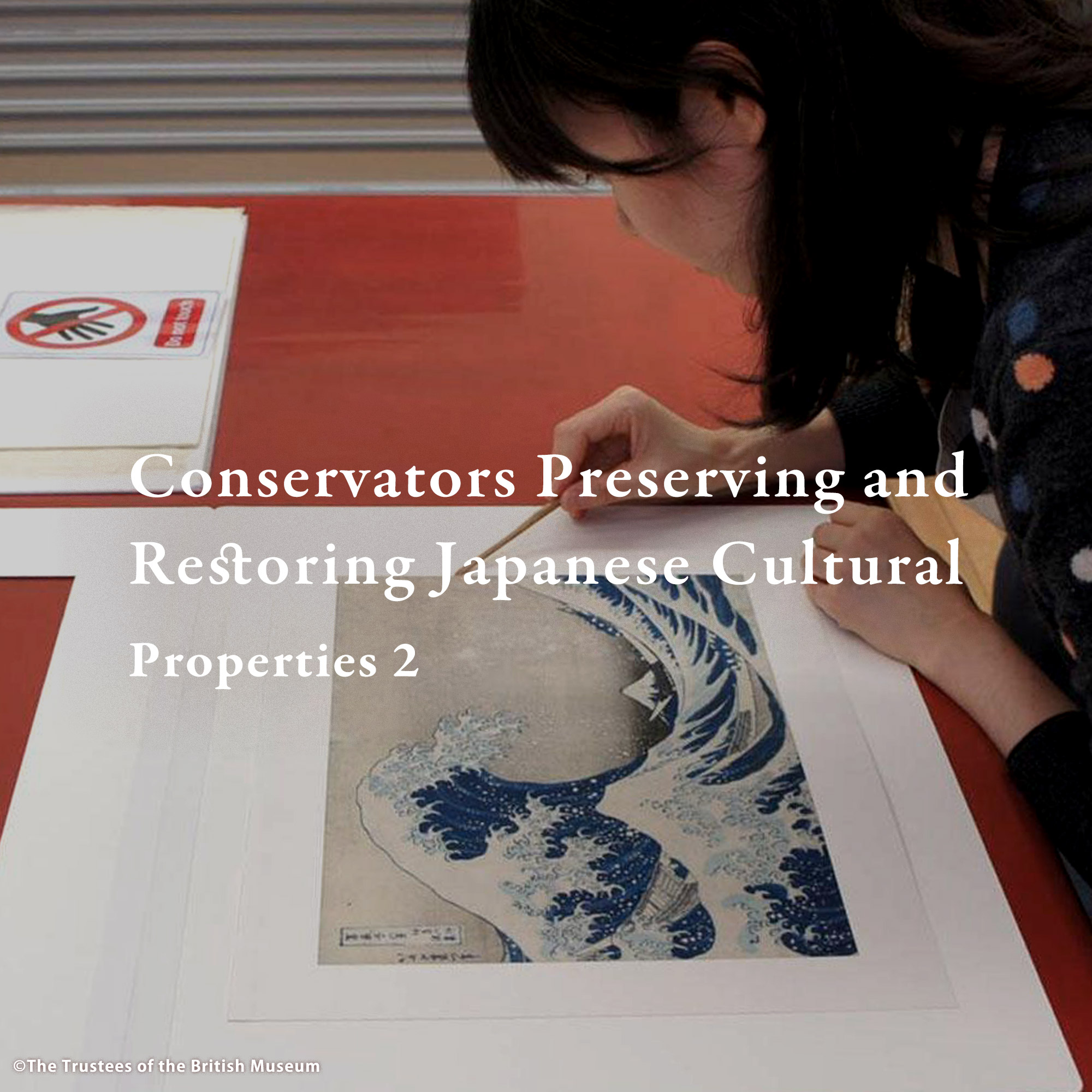
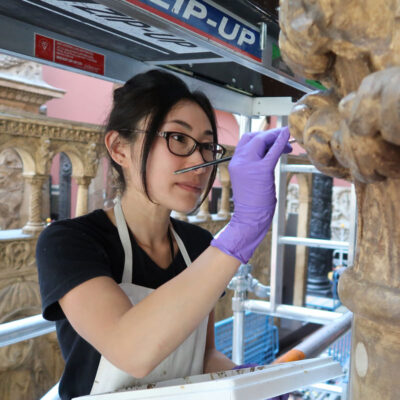
Our interview took place in London, England’s capital city, at a tatami-floored conservation studio within the world-famous British Museum, where Japanese cultural heritage objects are being cared for on a daily basis. There, we spoke with Kusunoki Kyōko, a Japanese conservator working in this studio.
Japanese Paper and Brushes – Essential Tools Overseas
Morio
Washi is used for repairs even in Europe because of its long, thin, yet strong fibers, right? Does the British Museum have a large stock of washi?
Kusunoki
Yes, we have good amount of stock, but as we do use it constantly, we frequently need to replenish the supply. Delivery of some specific types of washi may take a few years. We also have dozens of boxes of Chinese Xuan paper purchased over the years – our Chinese paintings conservator tells us it is now getting harder to purchase Xuan paper of comparable quality.
Morio
In Japan, we often hear that the number of producers of raw materials for washi has dwindled, papermaking craftspeople are aging without successors, and other problems. Is the situation similar in China then?
Kusunoki
There seem to be quite a large number of factories making paper in China. The culture of calligraphy is still highly valued, and artists and students use large quantities, so there is considerable demand.
But demand is one thing and quality is another. Paper made through mechanized production systems can feels different from paper made using traditional methods.
Morio
So, do you avoid using machine-made paper?
Kusunoki
I do use machine-made paper as a temporary support during conservation treatments, but not for permanent linings.
Morio
And I guess all your tools, too, must be brought from Japan. Do you always obtain them from the same place?
Kusunoki
Yes, we purchase them in Japan. For brushes, there are fewer sources than before. In Tokyo, we can still purchase brushes from Kobayashi Brush Shop. In Kyoto, we used to purchase them from Nishimura Brush Shop, but after the owner passed away and no one succeeded the business, we can no longer place orders there.

Nori
Nori are the various types of traditional natural adhesives used in scroll mounting. The three main types are as follows:
shōfu nori: paste made from wheat starch.
funori: paste made by extracting the adhesive components from seaweed.
nikawa: a traditional adhesive made from collagen extracted and solidified from the hides and bones of deer, cattle, rabbit, fish, and other animals.
Morio
For adhesives, do you use those made with natural ingredients only, or some made from synthetic resins?
Kusunoki
Ordinarily we use shōfu nori (wheat starch paste), funori (seaweed paste), and nikawa (animal glue), but sometimes we do use synthetic adhesives such as acrylic resins or cellulose derivatives.
Morio
So the natural adhesives are the best, but if they are difficult to apply, you might sometimes use a synthetic material?
Kusunoki
Yes. Also, when the surface of a paint layer comes off when touched with a brush, we must first stabilise it with a synthetic resin or cellulose-based adhesive. Once it is firm enough to be touched with a brush, then we can secure it using nikawa glue. When you are working with water-soluble colourants, they can bleed whether you use water or a solvent, so all we can do is work with extreme caution, checking the surface with a microscope and taking it one very small step at a time.
Morio
What looks especially difficult is that since paintings have a variety of colors as well as gold leaf, even if you manage to stabilise one color, the color next to it might respond in a completely different way.
Kusunoki
Yes, but the ways in which paint layers respond differently to adhesives are actually very interesting to observe.
Senryō/Ganryō
Senryō: Dyes that are extracted from plants and other natural materials. They are water-soluble. The colors are directly applied by soaking textiles or papers in a dye-bath. Used for dyeing threads, fabrics, and other materials.
Ganryō: Pigments are powdered colourant derived from earth, minerals and some solidified dyes. . They are primarily used for paintings. These colors are mixed with nikawa animal glue, which acts as a binder, and then are applied to paper or textiles substrates.
Working with One-of-a-Kind Pieces
Morio
It must be rather frightening working with original, irreplaceable pieces. What kinds of tasks make you feel that way most intensely?
Kusunoki
I would say it is when we need to “add” something to an object. Removing secondary materials from an object is also very tense, but it is really the act of adding that feels the most frightening, because you may be altering the object itself.
Morio
When you say “add,” do you mean applying adhesive or doing inpainting?
Kusunoki
Yes – both. Using water can be nerve-racking in the first place!
Morio
I once saw a work on paper being placed in a large vat of water for cleaning. Do you sometimes do that?
Kusunoki
I have never tried that method, though it is common in Western paper conservation techniques. When we clean a painting, we lay the work on sheets of blotting paper and apply water as a fine spray – the blotting paper draws out the impurities.
Conservators working on Chinese paintings use warm water for cleaning, which also helps with the subsequent removal of old backing papers. They apply warm water using a brush to wash the painting, but this also loosens the old adhesive, so they can then carefully peel off the backing papers. They do that, of course, only after first confirming the painted layer is stable and in good condition.
Morio
Are there differences from one country to another in what are considered good repair methods?
Kusunoki
Yes. Between Japan and China there are differences especially in policy regarding retouching or toning repairs.
In Japan, we try to make the damaged part less noticeable by toning it, but we do not recreate missing details.
But traditionally in China, if missing areas are left blank, this could be perceived as the restoration work being incomplete. If a line has been lost, it may be carefully and naturally painted back in, whilst restoring the colors as much as possible.
In the Hirayama Studio, each painting is carefully treated in accordance to the culture from which it comes.
Morio
So even within Hirayama Studio, different approaches to conservation are followed. But are the fundamental practices generally shared by your Japanese colleagues?
Kusunoki
Yes. Particularly in the case of designated Important Cultural Properties, the policy is that paintings and calligraphy are not retouched and nothing is added.
Original
The part of a work as it was produced by the artist is considered the “original,” not repaired or restored. In some cases it is difficult to draw a clear line defining what should be regarded as the “original.”
Hoten/Hosai
Hoten: “Infill.” Adding new material to replace an area where the original substrate has been lost.
Hosai: “Inpainting.” Adding color to infilled areas so that they blend in with original parts of the work. This finishing process softens the visual impact of the infills.
Morio
That policy was not established long ago, I believe. Did it change as Western ideas were absorbed and gradually evolve over time?
Kusunoki
Yes, precisely. When we examine traces of repairs made long ago, we can see that some retouching was done. In such cases we face a difficult dilemma in deciding whether to remove the retouching or leave it as it is.
Morio
Do European conservators express surprise at any Japanese conservation practices?
Kusunoki
When I first joined the studio in Nara, what surprised me most was that the mounts of paintings would be completely replaced. I imagine that reaction is probably exactly the same for Western conservators. I remember how startled I was to see that the old mount was simply removed

Morio
Does that mean the mount was not original?
Kusunoki
Yes. And another reason may be that, according to our contemporary sense of color and patterns of mounting silk, the mount can seem mismatched and interfere with appreciation of the painting.
Furthermore, the mount is not only a way of framing or setting off the work. It also plays an important role in its preservation. Sometimes it is replaced in order to provide a stronger support, assuring the painting will last another 100 or 200 years. Still, I feel the trend over the past ten years or so has been to reuse the former mounting silk as much as possible.
Morio
Does reusing the mounting silk mean restoring and reusing it?
Kusunoki
Yes. However, the reason it would be reused is not simply because it is “original.” It may not be the original mounting silk, but we reuse it because it is thought to convey the aesthetic of the time the painting was last restored. And it would only be reused if it was still strong enough to safely support the painting.
Association for Conservation of National Treasures (ACNT)
This is an organization of professionals engaged in the conservation and restoration of cultural properties, mainly works of art and decorative art including hanging scrolls, folding screens, handscrolls, and historical documents. Currently 10 studios are members of the association.
Morio
I suppose it is difficult to decide at what point in time a painting should be conserved. At the British Museum, are you the one who makes the final decision about mounts?
Kusunoki
For the paintings conserved in collaboration with the Association for Conservation of National Treasures (ACNT), the final decisions are made in consultation with the ACNT’s representative, myself, and the British Museum’s curators. For other types of project—such as those requiring remounting for museum exhibitions or loans—I make the final decision. But I often send photos to my senior colleagues in Japan and ask for their advice!
Morio
So you do have considerable communication with experts in Japan.

Morio
At the Hirayama Studio, training and knowledge exchange of scroll mounting conservation are carried out as part of a program funded by the Sumitomo Foundation (Collaborative Conservation Project with the ACNT: The Conservation of Japanese Paintings in the British Museum).
Members of the ACNT visit the Hirayama Studio and work together with British Museum staff. This allows the British Museum staff to gain deeper understanding of Japanese conservation, while also providing the ACNT’s conservators with opportunities to broaden their horizons by working overseas. I feel that this system of mutual learning is a wonderful idea.
Kusunoki
Thank you. That is very nice to hear. Having colleagues from Japan come here to work with us—and hearing about the projects they are currently working on back in Japan—I learn a lot from them as well.
Many Japanese colleagues who have visited the studio tell me that working in a studio overseas is both enjoyable and stimulating. Projects where we can learn from each other are truly ideal. During their visits, we have a “study day,” during which we visit various places outside the Hirayama Studio, such as conservation studios for three-dimensional objects and textiles—and I think the Japanese colleagues gain a great deal from these visits.
Also, Japanese colleagues invariably mention that it is fascinating to observe Chinese techniques. We are familiar with them in theory, but we rarely have the opportunity to see them being carried out in person. And precisely because they are so similar to what we do, we find the subtle differences are fascinating.
Morio
The British Museum holds various events for children. Could you tell us how conservators are involved in those events?
Kusunoki
I myself have not participated, but I did provide a video for a “Sleepover” event when children are invited to stay in the Museum overnight.
Also, though not an event, the British Museum publishes a periodical for children, and I recently wrote an article giving an easy-to-understand explanation of the work of a conservator. I described conservators as “general practitioners,” the local doctors who take care of the health of the collection; we are the doctors who care for the Japanese paintings.
Though not limited to children, in 2017 we organized a tour for blind visitors during the Katsushika Hokusai exhibition. For that event, I was asked to make available some tools and materials that we use in our work. I prepared paintbrushes, paint trays, and other items that the visitors could touch.
Morio
So even in events designed for visitors with visual impairments, they incorporate the perspective of conservation. It’s good that they are able to touch such items directly.
Kusunoki
Yes, being able to touch tools and materials greatly enhances understanding.
In Japan as well, displays that allow visitors to touch materials have been increasing. When I visited the Tokyo National Museum there were displays in the crafts gallery with videos showing how mother-of-pearl is inlaid, along with the materials that visitors could touch. On such occasions, I myself try to take full advantage of the experience of touching objects.

Morio
Of all the paintings you have conserved so far, which one was the most exciting to work on?
Kusunoki
It’s difficult to choose just one, but Sakurai Kōun’s copy painting of the Hōryūji Kondō wall no. 9 mural left a particularly deep impression. It was painted on extremely thin paper which you could see through, and it was very large (310 by 260 centimeters) so handling it during the treatment was quite challenging. We applied six-layers of lining paper to mount it as a hanging scroll, and it was thrilling to see how the colors and drawing lines had the illusion of greater depth after lining.
Morio
When you are conserving paintings, you have them right in front of you. Is that quite different from seeing them in an exhibition?
Kusunoki
Well, yes, it is different. We tend to focus mainly on details like the particles in the paints. Rather than approaching the work as a whole to enjoy, we pay attention to whether there are any tears or where the surface has become “floaty” (Laughs).
So sometimes we aren’t even aware of the impression of the whole work! Once it is hung in the gallery, we often go to see it and realize only then, “Oh, that’s what it looks like!”
Morio
This might seem a strange question but do conservators have any special quirks? Like if you are walking along the street and you see paint peeling off on something do you automatically imagine repairing it, or something like that?
Kusunoki
Yes, I do! When I see paint peeling, I immediately start thinking how to approach the consolidation, like ‘there’s where I can start consolidating’—that sort of thing. (Laughs)
When I move out of an apartment, I’d often infill and retouch any holes on the walls, secretly taking pride in the fact that no one would ever guess where the repairs were.

Morio
The environment is changing rapidly, and culture and science are changing as well, do you think that the traditional mounting techniques practiced until now should continue unchanged? Or do you think they will need to evolve?
Kusunoki
Speaking very generally, I do think that it would be good for our profession to become more open from now on. It is true our techniques and methods are firmly rooted in tradition, but even “tradition” is something that continually changes. In that sense, we ourselves need to be “creating tradition,” by incorporating the results of recent research into our techniques and materials. I feel our craft has to become more open.
Morio
Yes, one could say that about Japan’s traditional crafts in general.
Kusunoki
Still, I wonder what the best way is to make them more open. There is great appeal, for example, in showcasing beautiful photos and videos via Instagram, but there is a lot of behind-the-scenes information that is not explained, and I am rather concerned about how that can be shared.

After the Interview
How best to make the mounting of handscrolls and hanging scrolls better understood is indeed an important question. This a question not only for scroll mounting but for the work of conservation as a whole.
For example, hearing about the technique of “feather cutting” washi paper made me want to try it myself. If I actually try the technique, I would get a vivid feel for its difficulty and effectiveness, and also through that procedure see for myself the length of the fibers in washi paper. Gaining understanding through the physical senses must be interesting.
Until now, you may not really have looked closely at hanging scrolls, but when you see one next, you might try imagining how many layers it consists of and wonder whether it has inscribed somewhere details of the last person who did repairs on it.
I wanted to ask Kusunoki Kyoko more about what she meant by “behind-the-scenes information,” but I hope there will be another opportunity to report further to gain more perspective on the hidden practical aspects of the conservator’s craft.
Cooperation
The British Museum
Great Russell Street, London, WC1B 3DG
One of a kind: the Hirayama Conservation Studio
https://www.britishmuseum.org/blog/one-kind-hirayama-conservation-studio